italiano
Banda larga via cavo

Your Network Is Changing. What Should Better Power Efficiency Deliver?

Your Network Is Changing. What Should Better Power Efficiency Deliver?

AT SCTE TECHEXPO IN ATLANTA, ENERSYS ASKED: “WHAT IS YOUR NETWORK ASKING POWER TO DO NOW?” 

That question belongs at the beginning of a network upgrade discussion. As operators select architectures and equipment, they should also reassess the required power capacity, system configuration, and efficiency under expected operating conditions.

Efficiency deserves a place in that discussion because conversion losses are a recurring cost. Addressing those losses during planned installation work may improve the economics of replacement. The case still depends on site conditions and the remaining service life and suitability of existing equipment.

KEY TAKEAWAYS

  • Lower energy consumption per byte can coexist with rising total electricity use. Assess upgrade savings against a defined alternative delivering the same required output.
  • Evaluate power-system efficiency across expected operating loads and configurations, rather than relying on peak performance.
  • Assess energy savings alongside capacity, space, serviceability and the full cost of implementation.
 

REDUCED ENERGY INTENSITY DOES NOT NECESSARILY MEAN LOWER ENERGY CONSUMPTION

In February 2025, Comcast reported a 40% reduction in electricity consumed per byte of data since 2019, alongside its goal to double network energy efficiency by 2030.1

The reported reduction concerns energy intensity, not total electricity consumption.

Consider a simple illustration. If traffic doubles while electricity consumption increases by 20%, energy consumed per byte falls by 40%. The network handles substantially more traffic for each unit of energy, even though overall consumption has risen.

Energy intensity helps operators assess how efficiently they accommodate traffic growth. Absolute consumption establishes how much electricity they use and is a fundamental driver of energy spend. The bill also depends on electricity rates and, where applicable, demand charges.

The industry’s move toward consistent reporting through SCTE 295 provides a stronger basis for tracking energy intensity.2 For an equipment decision, operators also need a comparison that holds the required output constant.

A site may consume more electricity after an upgrade because it supports additional equipment, while consuming less than it would have with a less efficient power system. For the same output and operating conditions, the difference is avoided energy consumption.

calculate.jpg


SMALL CONVERSION LOSSES DESERVE A PROPER CALCULATION

Power-conversion efficiency measures useful output power relative to input power. For a given output, higher efficiency reduces losses.

Those losses continue for as long as the equipment operates. Their significance depends on the load, operating hours and number of sites—not simply the difference between two headline percentages.

For illustration, a conversion stage delivering a constant 1 kW at 95% efficiency draws approximately 1.053 kW. At 96%, it draws approximately 1.042 kW. The difference is about 11 watts, or approximately 96 kWh over a year of continuous operation.

This is a simplified calculation, not a product comparison. It assumes constant output and efficiency and excludes equipment outside the conversion stage. Across a large installed base, those savings can accumulate. Whether they justify replacement depends on electricity prices, installation costs and the remaining service life of the existing equipment.

Peak efficiency does not settle that question. It describes performance at an optimized output load. Annual input energy consumption depends on the real output load over time and conversion efficiency under the corresponding electrical conditions. Texas Instruments’ measurement guidance illustrates why input voltage and load current must be specified when evaluating power-supply efficiency.3

In a modular power conversion system, the number of operating modules and the redundancy requirement influence the load carried by each module. A comparison should represent the system the operator will deploy.

USE THE NETWORK UPGRADE TO REASSESS THE SITE

Inside and outside plant require different assessments.

At a hub or headend, conversion efficiency may be considered alongside power capacity, rack space, redundancy and maintenance access. In outside plant, the assessment must reflect the supported load, enclosure conditions and field-service requirements.

Better efficiency may strengthen a project already needed for capacity or serviceability. It may also justify targeted replacement where measured losses and operating costs support the case. Neither conclusion should be assumed across an entire installed base.

The assessment should start with representative site data. SCTE 238 addresses measuring and baselining consumption in outside-plant equipment and power supplies, providing an industry basis for that work.4

The measurement boundary must be clear. A module-level test, a complete power-system measurement and a facility utility meter may each account for different equipment and losses. Their results cannot be compared directly without accounting for those differences.

Additional benefits need separate evidence. Reduced conversion losses may lower cooling requirements, but cooling-energy savings depend on the deployment environment and its cooling system. Likewise, a capacity increase or easier maintenance access should be assessed in its own terms.

GIVE EFFICIENCY A DEFENSIBLE PLACE IN THE INVESTMENT CASE

An upgrade proposal should answer four questions before asking an operator to accept its projected savings:

1. WHAT IS THE BASELINE?

Define measured consumption, useful output, the equipment included and the alternative against which savings will be assessed.

2. HOW WILL THE PROPOSED SYSTEM OPERATE?

Use representative loads and configurations that meet required capacity, redundancy and backup performance.

3. WHAT WILL IT SAVE?

Calculate annual energy savings and their value under the applicable electricity rate, stating the assumptions and assessing any demand-charge savings separately.

4. WHAT WILL IT COST TO ACHIEVE?

Include installation, integration and lifecycle costs, accounting for the remaining value of existing equipment.


“What is your network asking power to do now?” should influence the specification before equipment is selected. Suppliers should provide efficiency data for the proposed configuration and show how that performance translates into annual energy consumption under the operator’s expected load profile. Operators can then judge the savings alongside the capacity, space and service requirements of the upgrade.


REFERENCES
1. Comcast, “Internet Providers Introduce Industry’s First Standard for Network Energy Efficiency,” February 11, 2025. Link: https://corporate.comcast.com/stories/internet-providers-introduce-industry-first-standard-network-energy-efficiency
2. Light Reading, “Cable’s new power play gives network energy efficiency a jolt,” March 7, 2025. Link: https://www.lightreading.com/cable-technology/cable-s-new-power-play-gives-network-energy-efficiency-a-jolt
3. Texas Instruments, “Engineer It — How to test power supplies — Measuring Efficiency.” Link: https://www.ti.com/video/3872319706001
4. SCTE, SCTE 238 2017: Operational Practice for Measuring and Baselining Power Consumption in Outside Plant Equipment and Power Supplies. Link: https://account.scte.org/standards/library/catalog/scte-238-measuring-and-baselining-power-consumption-in-outside-plant-equipment-and-power-supplies/

About EnerSys

Sustainability


Caution Concerning Forward-Looking Statements
EnerSys is making this statement in order to satisfy the “Safe Harbor” provision contained in the Private Securities Litigation Reform Act of 1995. Any of the statements contained in this article that are not statements of historical fact may include forward-looking statements that involve a number of risks and uncertainties. A forward-looking statement predicts, projects, or uses future events as expectations or possibilities. Forward-looking statements may be based on expectations concerning future events and are subject to risks and uncertainties relating to operations and the economic environment, all of which are difficult to predict and many of which are beyond our control. For a discussion of such risks and uncertainties that could cause actual results to differ materially from those matters expressed in or implied by forward-looking statements, please see our risk factors as disclosed in the “Risk Factors” section of our annual report on Form 10-K for the most recently ended fiscal year. The statements in this article are made as of the date of this article, even if subsequently made available by EnerSys on its website or otherwise. EnerSys does not undertake any obligation to update or revise these statements to reflect events or circumstances occurring after the date of the article.

XM-Edge-teaser-3.jpg

UPGRADE POWER FOR WHAT THE NETWORK HAS BECOME

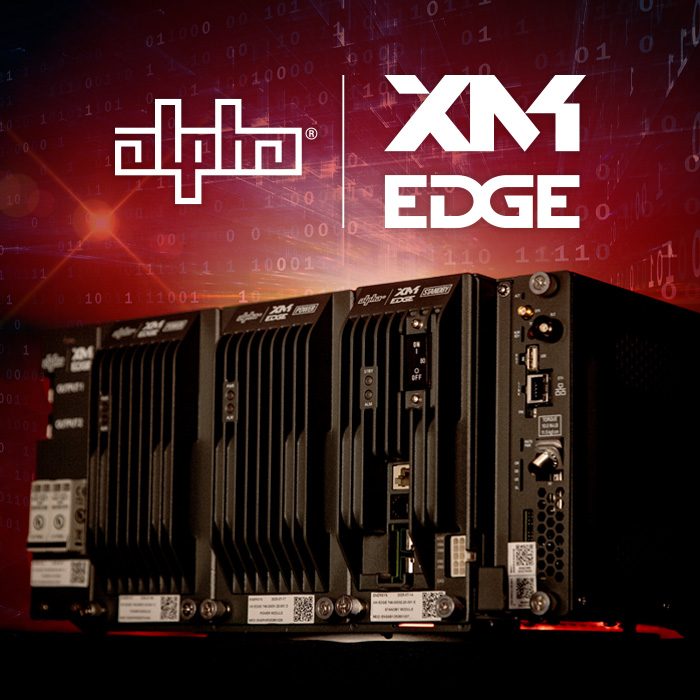
Broadband networks have changed. Outside plant power now has to support higher demand without adding unnecessary energy cost or operational burden. The Alpha XM Edge power system introduces a high-efficiency digital switch-mode architecture for outside plant networks.

EXPLORE Alpha XM Edge

AlphaCell-Catalyst-Logo-2.jpg


THE HEAT IS ON. YOU'RE PAYING THE BILL.

AlphaCell 4.0HP+ batteries are designed to improve electrochemical stability under variable operating conditions, helping reduce the mechanisms that contribute to higher operating cost and performance unpredictability across distributed outdoor networks.

EXPLORE ALPHACELL 4.0 HP+