Reliable grid operation depends not only on major network assets, but on the supporting systems that keep substations ready to respond. Batteries, chargers and DC power infrastructure sit within that critical layer, supporting the protection, control and communications functions utilities rely on to operate the network, respond to faults and restore service. Across the wider grid, data-led monitoring is already helping utilities improve asset visibility, prioritise risk and plan maintenance more effectively. Much of that focus has been directed towards visible network infrastructure, including overhead lines, weather-exposed assets, fault detection and grid monitoring. The same principle now needs to be applied more deliberately inside the substation.
For reliability, SCADA (Supervisory Control and Data Acquisition) and maintenance teams, this raises an important question: if asset intelligence is becoming central to grid planning, how much visibility do they really have into the condition of their substation battery and DC power systems? This is not about replacing scheduled maintenance or engineering judgement. It is about adding a stronger evidence layer between planned inspections, so teams can identify abnormal behaviour earlier, understand asset condition more clearly and make better-informed decisions about maintenance, lifecycle planning and operational readiness. In this article, Dr Thomas Verghese, Business Development Manager at EnerSys, explains why battery and DC power visibility should form part of modern substation reliability planning.
The visibility gap
Battery systems have never been overlooked because they are unimportant. They may be overlooked because little changes from one maintenance visit to the next, or at least that's what everyone hopes. While utilities are building stronger data-led insight across exposed grid assets, battery and DC power systems inside the substation can remain comparatively quiet, passive and under-observed until inspection, testing or replacement brings them into focus. That matters because batteries, chargers and DC power systems support protection, control, communications, SCADA infrastructure, breaker tripping and switching functions when they are needed most. Nobody notices a battery system that works properly. The difficulty is that problems often develop quietly. For utilities investing in AI, analytics and predictive asset management, the opportunity is to bring the same mindset inside the substation. The priority is not to overstate AI. It is to improve visibility around the backup power systems that support operational readiness.
The critical DC power layer underpinning grid reliability
Substation reliability is often discussed through its major equipment: transformers, switchgear, breakers, relays and communications infrastructure. Battery systems and chargers are largely treated as supporting components: necessary, understood and largely passive until maintenance or replacement is required. That view understates their role. The expectation is straightforward. When protection and control systems need DC power, the battery must deliver it immediately. It will spend much of its life in standby, but when called upon it has to support essential DC loads, including protective relay operation, breaker tripping, control systems, communications equipment, SCADA and telemetry infrastructure, switching and restoration activity.
For protection and control, battery visibility is therefore more than a maintenance issue. DC power availability underpins relay operation, breaker tripping, telemetry, communications and switching activity. If the health of that layer is only reviewed periodically, teams may have limited context around how the system is behaving between formal inspection and test events.
The challenge is that readiness is not always visible. Battery condition, charger performance and overall DC system health change over time. Age, temperature, charging conditions, discharge history, installation environment, maintenance practices and connection integrity all influence long-term performance. Some issues develop gradually and become visible through trend analysis, while others may only emerge during inspection, testing or an actual demand event. Traditional maintenance regimes remain essential. Visual inspections, voltage checks, charger checks, impedance or internal resistance testing, capacity testing, maintenance records and corrective action all have an important role. Monitoring adds value by improving the picture between those planned activities. It can help teams review operating data such as float voltage, float current, temperature, charge activity, discharge events, alarms, warnings and alerts, so they can assess whether site conditions or battery performance warrant closer review. This is not about monitoring every asset for the sake of it. A remote substation has a different risk profile from a site close to a maintenance depot. A mission-critical installation may justify closer visibility than a lower-risk location. A substation with ageing batteries may need a different level of review from one where the backup power systems have recently been upgraded. Stronger, smarter asset strategies recognize those differences.
What battery data reveals about substation reliability
Battery monitoring is not a single step from a manual inspection process to an AI-driven predictive model. It sits on a wide spectrum. Basic monitoring improves access to operating data. Condition visibility helps teams understand whether assets are behaving within expected limits. Trend analysis allows changes in behavior to be reviewed over time. AI cannot compensate for poor-quality data. Reliable data, engineering judgement and clear maintenance processes still determine whether monitoring delivers value.
Utilities are also working with fewer experienced field engineers while managing larger and more geographically dispersed asset portfolios. Better condition information helps maintenance teams prioritize where limited resources will have the greatest impact.
For substation battery systems, the first step is often more straightforward: teams need a clearer view of what is happening across the battery and DC power layer between maintenance visits. Battery monitoring can help reveal operating data such as voltage, temperature, charge activity, discharge events, energy throughput, warnings and alerts. Depending on the system and configuration, that visibility can help teams investigate abnormal behavior, prioritize follow-up checks and support better conversations between reliability, maintenance, protection and control, asset health and procurement teams.
In practical terms, monitoring helps teams ask better questions:
- Are battery temperatures remaining within expected operating limits?
- Has there been a discharge event that needs review?
- Have new warnings appeared since the last inspection?
- Is the battery behaving as expected for its age, duty and environment?
- Does the maintenance plan reflect the condition and criticality of the site?
- Is battery data being reviewed alongside charger behavior, maintenance records and test history?
These are operational questions, not abstract data questions. They move the conversation beyond calendar-based maintenance alone and bring condition into the decision-making process. Monitoring does not remove the need for inspection. It gives engineers more information before they arrive on site, helping teams decide what to look at, where to prioritize follow-up, and how to interpret asset behavior between scheduled maintenance events.
From periodic inspection to condition-led maintenance
Periodic inspection remains central to substation battery maintenance. Standards, manufacturer guidance, internal procedures and site criticality all shape how maintenance is planned, completed and documented. The role of monitoring is to add condition data to that established maintenance model, not to bypass required inspection, testing, records or corrective action. Condition-led maintenance does not mean abandoning scheduled maintenance. It means maintenance decisions are supported by better evidence between planned inspection visits.
A periodic model is built around scheduled activity. The next inspection, test or maintenance task is planned according to time, standard, internal policy or known asset age. That model remains important, but it can leave teams with limited visibility between scheduled events. Condition-based maintenance adds operational information between those scheduled activities. It asks what the asset is showing between checks, where behaviour is changing and which sites may need closer review. This is not automation replacing engineering judgement. It is data supporting engineering judgement. This is particularly valuable where substations are remote, unmanned or access-controlled substations, where every site visit carries a cost in planning, travel, access and field resource. It also matters across mixed installed bases, where battery type, charger arrangement, asset age and duty profile can create different visibility needs.
How the EnVision™ Connect system monitor strengthens the asset intelligence layer
The move towards better battery visibility does not have to begin with a complex AI program or a major change to existing practices. In many cases, the more valuable starting point is clearer, more accessible battery data. EnVision™ Connect system monitor was developed with that objective in mind. For selected PowerSafe® and DataSafe® batteries with factory embedded sensors, it provides wireless access to real-time and historical battery performance data wirelessly. The system records voltage and temperature and provides app-based access to information including charge and discharge activity, temperature, energy throughput, plug-ins, warnings and alerts.
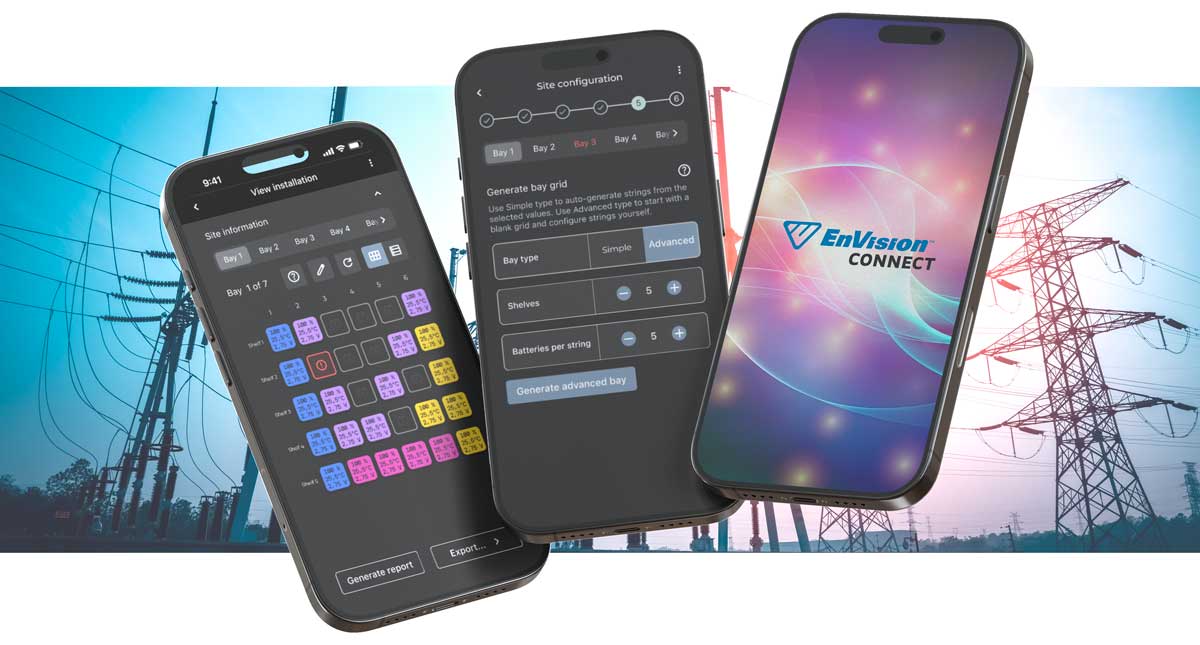
That information helps maintenance teams understand what has happened at a site before travelling there. A discharge event can be reviewed, temperature history checked and alerts investigated before engineers arrive. Over time, this gives utilities a clearer view of battery condition across multiple substations and supports more targeted maintenance planning. The value is not in treating one tool as the answer to asset intelligence. The value is in giving maintenance and asset teams better information so they can make more informed decisions. In suitable applications, that means improved visibility, stronger planning and greater confidence in the condition of the DC power systems that support critical substation functions.
Battery monitoring works best when it sits alongside established maintenance practices, not apart from them. It should be reviewed together with charger behavior, maintenance records and test history, so teams can develop a more complete picture of site condition. In that way, monitoring becomes part of the maintenance workflow rather than a separate task.
How utilities can assess the battery visibility gap
Utilities reviewing substation reliability should begin by asking how much they know about the condition of their battery and DC power systems between scheduled inspections. That question can quickly expose differences across multiple substations. Some sites may already have sufficient visibility for their risk profile. Others may require closer attention because they are remote, ageing, access-constrained or critical to protection and control functions. The purpose is not to apply one monitoring model everywhere. It is to identify where better visibility could materially improve maintenance planning and lifecycle decision-making.
A practical review should consider six areas:
|
1. SITE CRITICALITY
High-criticality, remote, unmanned or difficult-to-access substations may justify closer visibility into battery and DC power system health than sites that are easier to maintain. Criticality should shape the level of monitoring required.
|
2. EXISTING MAINTENANCE MODEL
Review how battery systems are inspected, tested and documented, and whether the current model gives teams enough visibility between scheduled inspections.
|
|
3. BATTERY CONDITION AND ENVIRONMENT
Age, temperature, charge conditions, discharge history, maintenance records and test results all influence asset health. Monitoring data can help explain changes in battery condition and identify where further investigation may be required.
|
4. DATA ACCESSIBILITY
Battery data has limited value if it is difficult to retrieve or interpret. Utilities should assess how performance data is accessed, who can view it, how warnings are handled and how information is shared with maintenance, reliability and asset health teams.
|
|
5. INTEGRATION REQUIREMENTS
Where monitoring data is expected to integrate with charger systems, SCADA, asset-management platforms or maintenance reporting processes, those requirements should be confirmed before specification. Charger compatibility, SCADA visibility, alarm handling, data export, reporting workflows and ownership of maintenance records should all be reviewed against the specific system architecture.
|
6. LIFECYCLE PLANNING
Battery monitoring should support long-term replacement planning as well as day-to-day maintenance. The objective is not more data for its own sake. The objective is inform better decisions across the battery lifecycle.
|
Rethinking battery monitoring across critical substation environments
Before specifying or expanding substation battery monitoring programs, utilities should consider where additional information would make the greatest operational difference. The most useful review questions are often operational rather than theoretical.
Key questions include:
Making battery visibility part of substation reliability planning
AI and predictive analytics are changing how utilities think about asset management. Effective asset management should include not only the assets that are easiest to monitor, but also the systems that support protection and control inside the substation. Battery systems, chargers and DC power infrastructure may sit quietly in the background, but they support essential reliability functions. Protection, control, communications, switching and recovery all depend on DC power being available when required. That makes visibility into battery and DC power system health a strategic reliability issue, not a narrow maintenance concern.
Specifying the right battery system is only part of the task. It is whether the utility has enough visibility into how that system is performing across the lifecycle. For utilities reassessing substation reliability, the next step is to review not only backup power capacity and maintenance intervals, but also the level of visibility available across battery and DC power system health. EnerSys works with utilities to assess where additional monitoring, condition data and lifecycle planning could strengthen critical DC power environments and long-term asset management.
FREQUENTLY ASKED QUESTIONS