THERMAL PERFORMANCE AND HIGH-TEMPERATURE UPS OPERATION

What is thermal performance and high-temperature UPS operation?

Thermal performance and high-temperature UPS operation refers to the ability of a data center UPS to maintain standby readiness and deliver critical power, even amidst high temperatures which can impact upon service life and energy efficiency.

HOW DO UPS ENERGY STORAGE SYSTEMS INFLUENCE ENERGY AND COOLING COSTS?

Whether it’s inefficient float charging, inefficient discharge and recharge performance, or inefficient cooling, a structured assessment can help identify optimization opportunities. 

REQUEST A DATA CENTER UPS ENERGY STORAGE SYSTEM THERMAL PERFORMANCE REVIEW

◼ Structured analytical review by an EnerSys data center specialist.
◼ Assessment of current UPS energy storage configuration and performance assumptions.
◼ Optional commercial proposal provided following technical review.

BOOK YOUR review today

The AI boom: Powering and cooling the modern data center

The International Energy Agency (IEA) notes that in 2025, global electricity demand from data centers grew by 17%, while electricity consumption from AI-focused data centers grew by around 50%, highlighting the impact of the AI boom.1

The applications behind this demand are becoming more diverse, with AI compute increasingly divided between training and inference workloads. By 2030, inference is expected to account for a larger share of overall AI workload demand. Traditional non-AI workloads will remain important, but the trajectory is clear: growth pressure on data center capacity is being shaped increasingly by AI, particularly the combined impact of large-scale training clusters and always-on inference infrastructure.2

While racks for traditional IT applications would require around 5-10kW of power, AI racks are in the hundreds of kW and can reach 1MW.3

Innovations in technology—including direct-to-chip and liquid immersion cooling—are helping to make cooling more efficient. However, cooling continues to represent a significant share of data centers’ non-IT load.

UPS energy storage systems and hidden energy consumption

Behind the scenes, several factors can turn essential backup systems into hidden energy demands—increasing operational pressure.

declining-controlling-costs-banner.jpg

Read more: Controlling Data Center Costs with Smarter Battery Choices

Where the losses add up

Round trip efficiency (RTE): For energy storage systems undergoing repeated cycling in quick succession — such as for the purpose of load-smoothing — delivering a reasonable rate of RTE is essential. Systems with low RTE could mean higher electricity bills for less energy delivered during discharge.

Float charging: Inefficient float charging means your batteries draw more power just to stay ready. The result? Electricity bills could be up to 30% higher depending on battery design and operating conditions.4

Cooling Costs: Some batteries demand lower operating temperatures, forcing your cooling systems to work harder. Just 1°C lower can increase cooling energy demand and push energy costs up to 4% higher, eating into your margins every single day.5

declining-reduced-cooling-banner.jpg

Read more: The Benefits of Running Your Data Center Operation With Reduced Cooling

Optimizing thermal performance in UPS energy storage systems

Your UPS energy storage system is more than just often overlooked components which kick in to prevent downtime. Instead, UPS energy storage systems can be considered strategic assets—helping to drive down your data center costs.

WHAT DEFINES THERMAL PERFORMANCE IN UPS BATTERY SYSTEMS?

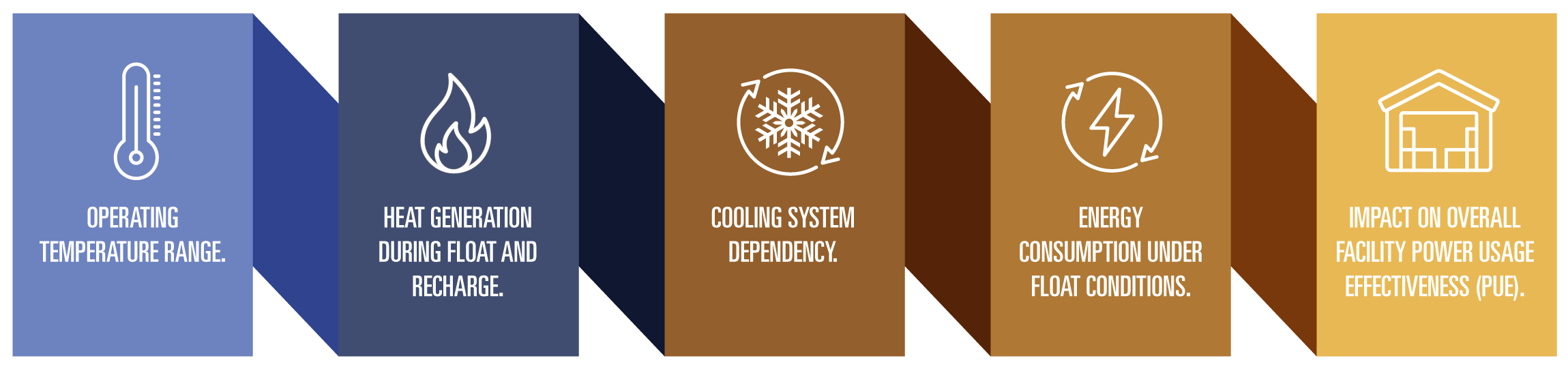
Thermal performance directly influences energy consumption, cooling demand, and infrastructure efficiency. In UPS energy storage systems this is typically evaluated across several operational factors:

datacenter-thermal-2026-v2.png

These variables help determine how battery systems influence both energy consumption and cooling requirements. Runtime is a specification. Performance is an operating condition in modern data centers.

EVALUATE YOUR UPS BATTERY THERMAL PERFORMANCE STRATEGY

Start Assess your UPS battery thermal performance in 4 steps:

1. FILL OUT THE FORM IN LESS THAN A MINUTE
2. HEAR BACK FROM AN ENERSYS SALES REPRESENTATIVE
3. GET A FREE, NO-OBLIGATION ANALYSIS OF WHERE YOUR DATA CENTER'S THERMAL AND ENERGY PERFORMANCE FACTORS MAY BE OPTIMIZED
4. RECEIVE TECHNICAL ANALYSIS AND, WHERE APPROPRIATE, A COMMERCIAL PROPOSAL ALIGNED WITH YOUR SITE REQUIREMENTS.

BOOK your evaluation today

EnerSys DataSafe Noir™: Controlling dynamic workloads in extreme conditions

Dynamic data center workloads are on the rise — especially from AI training in which entire GPU clusters can draw power in synchronicity.

Power demand can rise and fall rapidly. Under these conditions, data centers need UPS energy storage systems which are not just waiting to act as reserve power in the case of emergencies but are also ready to regularly assist with smoothing sudden power peaks.

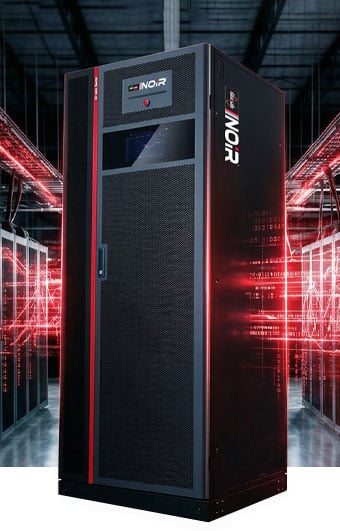
EnerSys DataSafe Noir™ is a lithium-based energy storage system which can respond to dynamic workloads energy efficiently and under high temperature operating conditions.

Testing shows:
• Safe operation at up to 42°C
• More than 98% discharge efficiency,
helping keep RTE under control
• Over 10 million micro cycles achieved at 30% depth of discharge and over 2.1million micro cycles achieved at 100% depth of discharge, displaying ability to handle repeated load spikes efficiently in quick succession

Explore datasafe noir

Established reserve power solutions with the Thin Plate Pure Lead (TPPL) advantage

Established TPPL solutions from EnerSys are engineered to support:

More efficient float charge
Standard lead-alloy batteries may undergo faster grid corrosion—in turn leading to higher internal resistance (IR) over time. Higher IR means more power is required just to maintain a float charge—contributing to increased energy consumption during float operation.

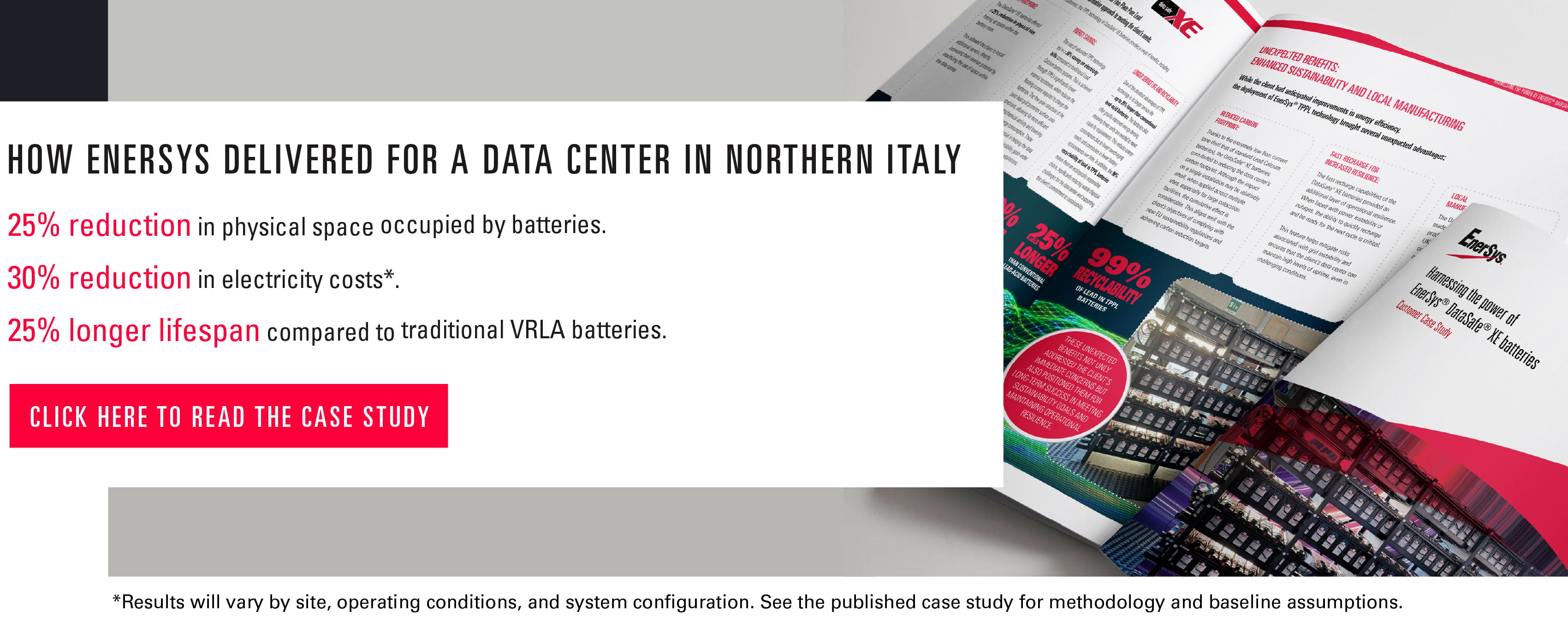
With pure lead grids, TPPL batteries use power more efficiently for float charging. One major colocation data center in northern Italy saw a 30% reduction in electricity consumption in a documented site deployment after switching to TPPL batteries*.

*Results will vary by site and operating conditions.

Higher temperature tolerance
Standard VRLA batteries are often specified to operate as low as 20°C. TPPL batteries can operate in higher temperatures—which may allow data center operators to use less energy for cooling, helping to reduce energy requirements.

datacenter-milan-case-study-2026-3.jpg

ADVANCED UPS ENERGY STORAGE SOLUTIONS FOR DATA CENTERS

UPS Energy Storage serves as the first layer of power resilience, providing the immediate power needed to keep critical systems running when disruptions occur.

Baterías

Sistema de almacenamiento de energía DataSafe Noir™

Ver detalles

DataSafe® XE Batteries

Ver detalles

Baterías DataSafe® HX+

Ver detalles

Baterías DataSafe® HX

Ver detalles

Baterías ODYSSEY® Performance

Ver detalles

References
1. International Energy Agency, Key Questions on Energy and AI, IEA, Paris, 16 April 2026, https://www.iea.org/reports/key-questions-on-energy-and-ai.
2. Chhavi Arora, Marc Sorel, and Pankaj Sachdeva, “The Next Big Shifts in AI Workloads and Hyperscaler Strategies,” McKinsey & Company, 17 December 2025,
4. DataCenterDynamics. The Impact of AI on Data Center Design. Available at: https://media.datacenterdynamics.com/media/documents/The_Impact_of_AI_on_Data_Center_Design.pdf.
5. Number based on an EnerSys case study of a data center in Milan, northern Italy.
6. U.S. Environmental Protection Agency (EPA), 5 Simple Ways to Avoid Energy Waste in Your Data Center, ENERGY STAR programme. Available at: https://www.energystar.gov/products/data_center_equipment/5-simple-ways-avoid-energy-waste-your-data-center.