Deutsch

LIFECYCLE ECONOMICS, RECYCLING AND END-OF-LIFE PLANNING

Data centers are under increasing pressure to meet environmental, regulatory and reporting requirements. And yet, your data center’s environmental progress may be influenced by less visible infrastructure factors.


How UPS energy storage can affect lifecycle economics, recycling and end-of-life planning

UPS energy storage systems are a crucial part of data centers’ environmental performance. Applications with high rates of discharge and recharge require battery technology which can cycle efficiently without need of frequent replacement. Even as reserve power waiting to step in in case of an emergency, some energy storage systems can optimize energy efficiency through float charging.

Towards the end-of-life stage, data center operators must also consider the amount of e-waste and recyclability of UPS energy storage systems.

REQUEST A DATA CENTER UPS ENERGY STORAGE SYSTEM LIFECYCLE AND SUSTAINABILITY REVIEW

◼ Structured analytical review by an EnerSys data center specialist.
◼ Analysis of your current setup.
◼ Optional commercial proposal following technical review.

BOOK YOUR review today

Environmental pressures on modern data centers

The global push toward net-zero emissions is reshaping industries, and data centers are at the heart of this challenge. Their high power demands make them significant contributors to greenhouse gas emissions. According to the World Economic Forum, data centers are responsible for around 1% of energy-related greenhouse gas emissions worldwide.1

A major driver of this surge is the rapid adoption of artificial intelligence (AI), which requires enormous computing power and cooling infrastructure. In 2025, global electricity demand from data centers grew by 17%, while electricity consumption from AI-focused data centers grew by around 50%, highlighting the impact of the AI boom.3 The pressure on power infrastructure is a combination of large-scale training clusters and always-on inference infrastructure.4

Across the globe, data centers are expected to deliver reliable services with minimal to zero downtime. Meanwhile, the industry must meet these expectations while aligning with environmental objectives to a greater or lesser extent, depending on regional specifics.

Governments tighten the rules

Governments around the world are increasingly enforcing rules to reduce data centers’ environmental impact:

United States

Several states now require energy usage and emissions reporting to improve transparency and efficiency. Texas’ SB6 even includes a “kill switch,” allowing grid operators to disconnect large consumers during emergencies.5

Ireland

The country’s new data‑center connection policy requires large centers (≥10 MVA) to provide onsite or nearby dispatchable generation or storage equal to their connection capacity, along with sourcing 80% of their annual electricity from new Irish renewable generation.6

European Union

The EU introduced a sustainability rating scheme for data centers over 500 kW, requiring annual reporting on energy efficiency, water use, renewables, and waste heat reuse to a central database.7

These regulatory developments are increasing the importance of lifecycle transparency, reporting, and infrastructure-level sustainability decisions.

eu-battery-laws-banner.jpg

Read more: EU Battery Laws Are Changing: Is Your Data Center Ready?

UPS Energy Storage Systems and Environmental Performance

How do data center operators improve sustainability metrics?

◼ Reduce electricity usage?
◼ Reduce cooling?
◼ Improve the handling of E-waste?

While UPS energy storage systems are not a silver bullet, they can help achieve all of the above. Key sustainability objectives for data center operators typically include reducing electricity consumption, optimizing cooling efficiency, and improving end-of-life material handling.

HOW UPS ENERGY STORAGE SYSTEMS CAN BECOME AN ENVIRONMENTAL HINDRANCE

For applications with dynamic workloads, UPS energy storage systems may need to do more than just act as reserve power in case of an emergency. They may also be regularly called upon to assist in smoothing synchronized spikes in power demand. Systems which cannot undergo discharge and recharge cycles efficiently may result in higher type 2 emissions as a result of increased electricity usage.

Inefficient float charging means your batteries could draw more power just to stay ready. The result? As well as electricity bills being up to 30% higher depending on battery design and operating conditions, you’re also draining more power from the grid, increasing indirect emissions associated with electricity consumption.8

Some systems demand lower operating temperatures, forcing your cooling systems to work harder. Just 1°C lower can increase energy demand and push energy costs up to 4% higher and negatively impact emissions associated with indirect energy consumption.9

Without a dedicated recycling scheme provided by your battery manufacturer, recycling can be costly and time-consuming depending on available infrastructure and local regulatory requirements.

EVALUATE YOUR UPS BATTERY LIFECYCLE AND SUSTAINABILITY STRATEGY

Understand how your UPS battery strategy affects energy consumption, cooling demand, lifecycle sustainability performance and environmental reporting.

1. FILL OUT THE FORM IN LESS THAN A MINUTE.
2. HEAR BACK FROM AN ENERSYS DATA CENTER SPECIALIST.
3. OBTAIN A NO-OBLIGATION TECHNICAL ASSESSMENT.
4. RECEIVE TECHNICAL ANALYSIS AND, WHERE APPROPRIATE, A COMMERCIAL PROPOSAL ALIGNED WITH YOUR SITE REQUIREMENTS.

BOOK your evaluation today

Turning UPS energy storage into an environmental advantage

Your UPS batteries are more than just often forgotten components. Instead, UPS batteries can be considered strategic assets which may help you meet environmental obligations more efficiently and in line with regulatory requirements.

WHAT DEFINES LIFECYCLE PERFORMANCE IN UPS ENERGY STORAGE SYSTEMS?

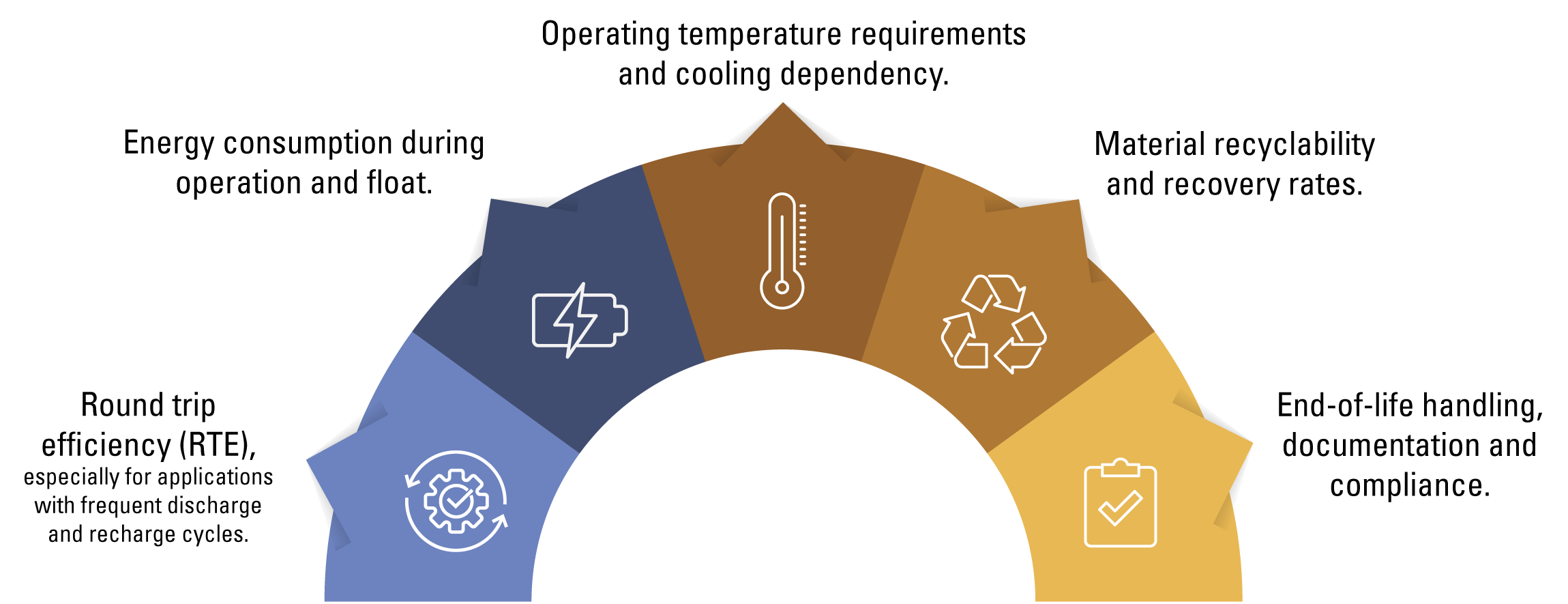
Lifecycle performance in UPS battery systems is typically evaluated across several factors:

datacenter-life-cycle-v2.png

These variables help determine how UPS energy storage systems influence both environmental impact and lifecycle cost. Runtime is a specification. Performance is an operating condition.

DataSafe Noir™: Efficient UPS energy storage for dynamic workloads

Dynamic data center workloads are on the rise — especially from AI training in which entire GPU clusters can draw power in synchronicity.

Power demand can rise and fall rapidly. Under these conditions, data centers need UPS energy storage systems which are not just waiting to act as reserve power in the case of emergencies but are also ready to regularly assist with smoothing sudden power peaks.

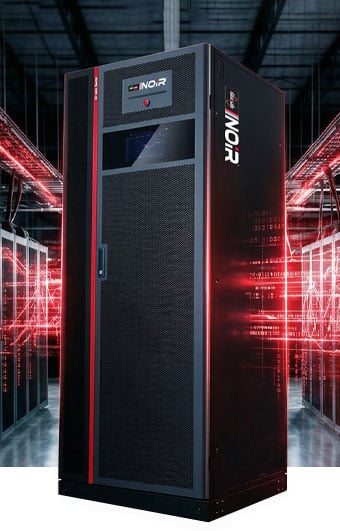
EnerSys DataSafe Noir™ is a lithium-based energy storage system which can respond to dynamic workloads energy efficiently — helping minimize environmental impact.

Key features include:
• 40-70% reduced footprint — supporting environmental obligations by reducing e-waste.
• Up to 600kW per cabinet — highlighting efficient use of power.
• More than 98% discharge energy efficiency — low energy loss during power discharge.

Explore datasafe noir

The EnerSys Thin Plate Pure Lead (TPPL) technology advantage

EnerSys Thin Plate Pure Lead (TPPL) technology solutions are engineered to support:

• Reduced indirect emissions associated with electricity consumption — with more efficient float charge and higher temperature tolerance, your data center could draw less electricity from the grid for float charging and cooling.
• High recyclability rate — TPPL batteries are up to 99% recyclable.
• Dedicated recycling scheme — EnerSys offers a complete battery recycling program in many regions, subject to availability and regulatory requirements.

Click HERE to find out more.

ADVANCED UPS ENERGY STORAGE SOLUTIONS FOR DATA CENTERS

UPS Energy Storage serves as the first layer of power resilience, providing the immediate power needed to keep critical systems running when disruptions occur.

Batterien

DataSafe Noir™ Energiespeichersystem

Details anzeigen

DataSafe® XE-Batterien

Details anzeigen

DataSafe® HX+ Batterien

Details anzeigen

DataSafe® HX-Batterien

Details anzeigen

ODYSSEY® Performance Batterien

Details anzeigen

References
1. World Economic Forum. (2025). 6 ways data centres can cut their emissions. Available at: https://www.weforum.org/stories/2025/01/6-ways-data-centres-can-cut-emissions/
3. International Energy Agency, Key Questions on Energy and AI, IEA, Paris, 16 April 2026, https://www.iea.org/reports/key-questions-on-energy-and-ai.
4. Chhavi Arora, Marc Sorel, and Pankaj Sachdeva, “The Next Big Shifts in AI Workloads and Hyperscaler Strategies,” McKinsey & Company, 17 December 2025, https://www.mckinsey.com/industries/technology-media-and-telecommunications/our-insights/the-next-big-shifts-in-ai-workloads-and-hyperscaler-strategies.3. E&E News, Rulemakers play catch-up as data centers multiply, https://www.eenews.net/articles/rulemakers-play-catch-up-as-data-centers-multiply/.
5. E&E News, Rulemakers play catch-up as data centers multiply, https://www.eenews.net/articles/rulemakers-play-catch-up-as-data-centers-multiply/.
6. CRU, Large Energy User Connection Policy – Decision Paper, https://cruie-live-96ca64acab2247eca8a850a7e54b-5b34f62.divio-media.com/documents/CRU2025236_Large_Energy_User_connection_policy_decision_paper.pdf.
7. European Commission. (2024). Commission adopts EU wide scheme for rating sustainability of data centres. Available at: https://energy.ec.europa.eu/news/commission-adopts-eu-wide-scheme-rating-sustainability-data-centres-2024-03-15_en
8.. Number based on an EnerSys case study of a data center in Milan, northern Italy.
9. U.S. Environmental Protection Agency (EPA), 5 Simple Ways to Avoid Energy Waste in Your Data Center, ENERGY STAR programme. Available at: https://www.energystar.gov/products/data_center_equipment/5-simple-ways-avoid-energy-waste-your-data-center.