Built on Discipline, Driven by Continuous Improvement

At EnerSys, sustainability is not a standalone initiative. It is embedded in how we operate, manage risk, allocate capital, and create long-term value. Our core values of accountability, continuous improvement, and operational excellence guide how we serve customers, support employees, and strengthen the communities where we operate.

As a global provider of energy storage and power solutions, we recognize the important role we play in supporting critical infrastructure, industrial operations, transportation networks, and defense applications. We are focused on improving efficiency, reducing waste, managing resources responsibly, and building resilient operations that can adapt to changing market conditions and customer needs.

GOVERNED BY POLICY. MEASURED THROUGH ACTION.

Our sustainability policies provide the framework for how we manage environmental, social, and governance priorities across our operations and value chain. These policies apply to employees, contractors, suppliers, and business partners worldwide and are overseen by our Board of Directors and senior leadership team.

We establish measurable goals, regularly evaluate our performance, and review our policies to ensure they remain aligned with evolving business needs, stakeholder expectations, and regulatory requirements. Through this disciplined approach, sustainability becomes more than a reporting exercise—it becomes a driver of operational excellence, resilience, and long-term value creation.

At EnerSys, sustainability is how we strengthen our business while helping customers address the growing demand for reliable, efficient, and secure power.


Our Sustainability Goals & Commitments


Alignment With SDGs

Sustainability-Unitednationsglobalcompact5-2024.jpg


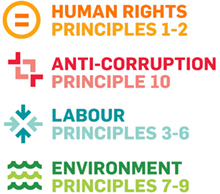
The United Nations Global Compact (UNGC) is a call to companies to align their business strategies and operations with ten universal principles on human rights, labor, the environment and more, and to take actions to advance societal goals. More than 20,000 companies in over 160 countries participate in the Compact, including EnerSys. Our corporate policies adhere to the UNGC. Our corporate policies and actions adhere to the UNGC’s 10 Principles.

Sustainability_unitednations-principals.png

Sustainability-Sustainabledevelopmentgoals5-2024.jpg


The 2030 Agenda for Sustainable Development, embraced by United Nations (UN) member states in 2015, outlines a global plan for peace, prosperity, and sustainability for current and future generations. Central to this agenda are the 17 SDGs, urging global action across developed and developing nations to address climate change, eliminate poverty, enhance health and education, reduce inequalities, and promote economic growth.

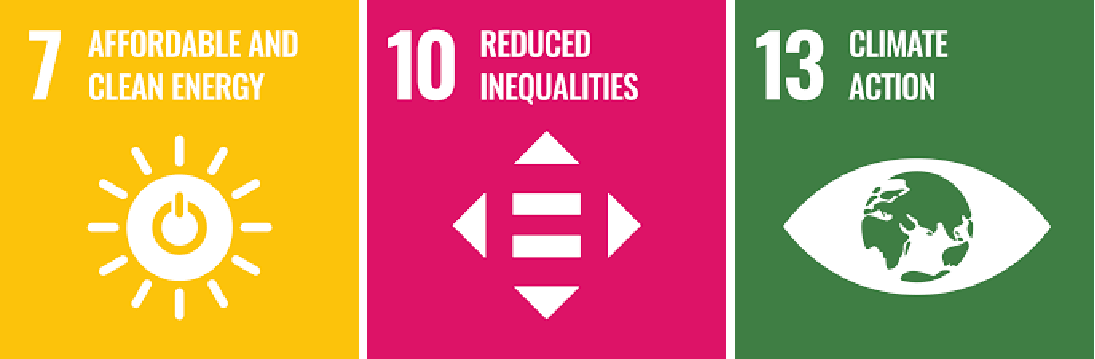
EnerSys is dedicated to advancing the SDGs, aiming to make a positive impact through our products, operations, community involvement, and workplace. We are focused on contributing significantly to the top three SDGs where we believe our impact is most substantial:

sustainability_commitment_developmentgoals.png

  • SDG 7: Affordable and Clean Energy
  • SDG 10: Reduced Inequalities
  • SDG 13: Climate Action

We aim to leverage the UNGC and the SDGs to further the transition to a low-carbon, clean energy future everywhere, for everyone. 


Sustainability Initiatives

As part of our growing sustainability commitment, EnerSys joined the following initiatives:

sustainability_initiatives_betterplants.jpg

U.S. DEPARTMENT OF ENERGY BETTER PLANTS PROGRAM

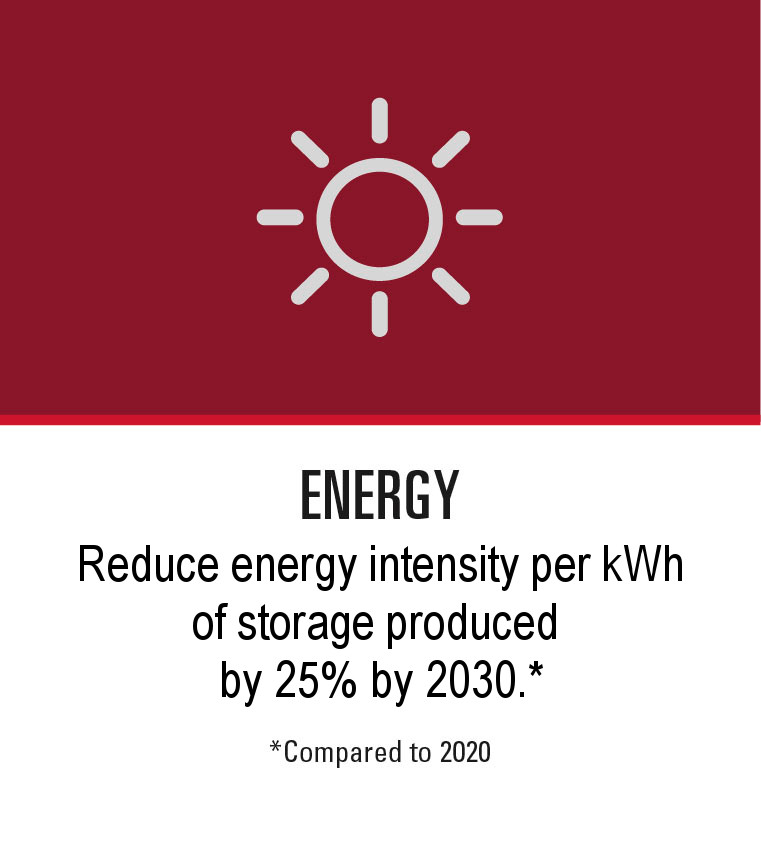
The U.S. Department of Energy’s Better Plants Program partners with top manufacturers to enhance energy efficiency, resilience, and economic performance. As a participant, EnerSys has pledged to reduce its energy intensity by 25% over the next decade, using CY2020 as the baseline year.

sustainability_initiatives_CEO.jpg

CEO WATER MANDATE

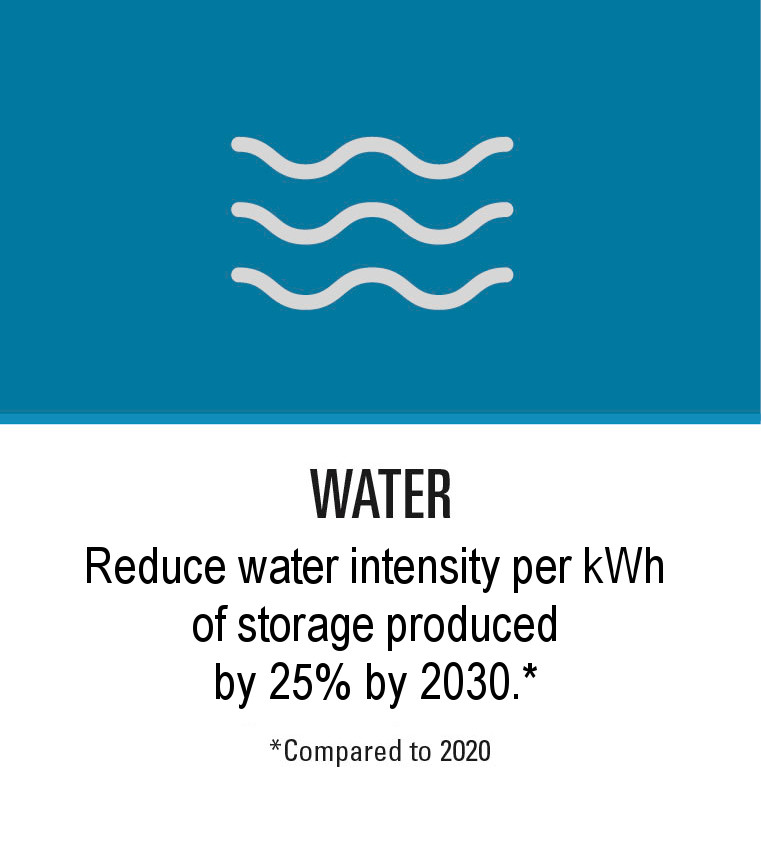
CEO Water Mandate is a CEO-led commitment platform for business leaders and learners to advance water stewardship and reduce water stress worldwide by 2050. Committed companies identify and reduce critical water risks to their businesses, seize water-related opportunities and contribute to water security and the SDGs. The Mandate has been endorsed by around 600 companies from various industry sectors and regions worldwide. Endorsing companies commit to action across six key elements and report annually on progress: 

  1. Direct Operations
  2. Supply Chain & Watershed Management
  3. Collective Action
  4. Public Policy
  5. Community Engagement
  6. Transparency

In 2026, EnerSys was recognized as one of TIME America’s Best Companies 2026 and as TIME Most Impactful Companies 2026. These rankings identified top-performing U.S. companies using a data-driven evaluation across employee satisfaction, financial strength as well as environmental, social and governance transparency.


Our Sustainability Journey

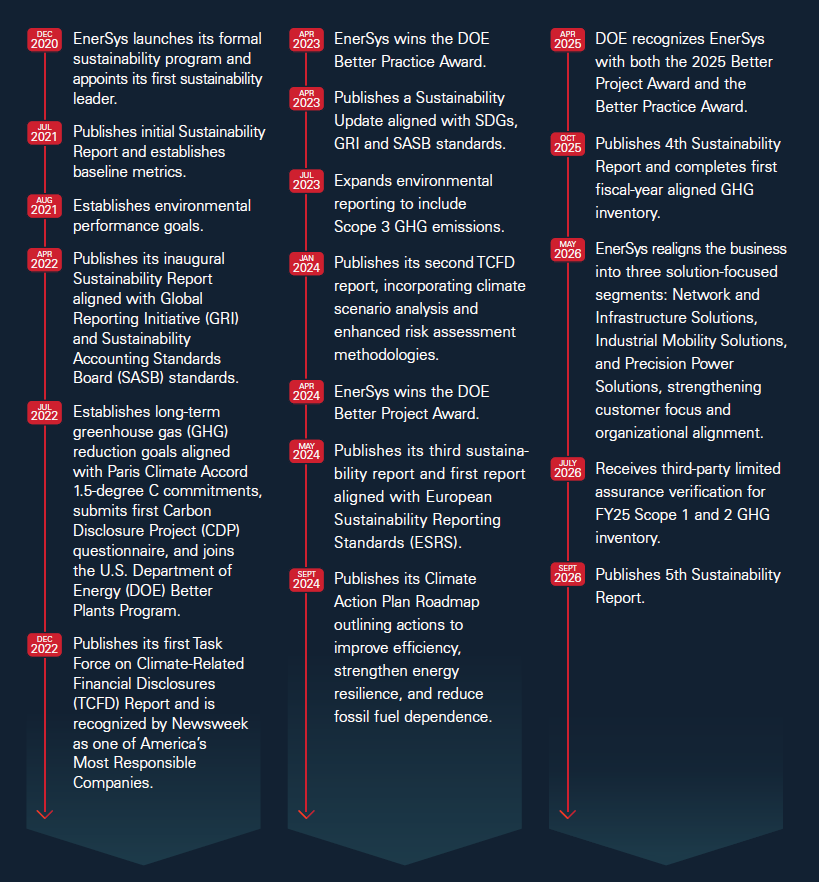
Since launching our sustainability program, EnerSys has continued to strengthen the governance, policies, goals, and reporting processes that support long-term value creation. Our approach focuses on operational excellence, responsible resource management, employee engagement, and transparent disclosure.

The timeline below highlights key milestones in the evolution of our sustainability program and demonstrates our commitment to continuous improvement, accountability, and alignment with internationally recognized reporting frameworks.


Our Stakeholders


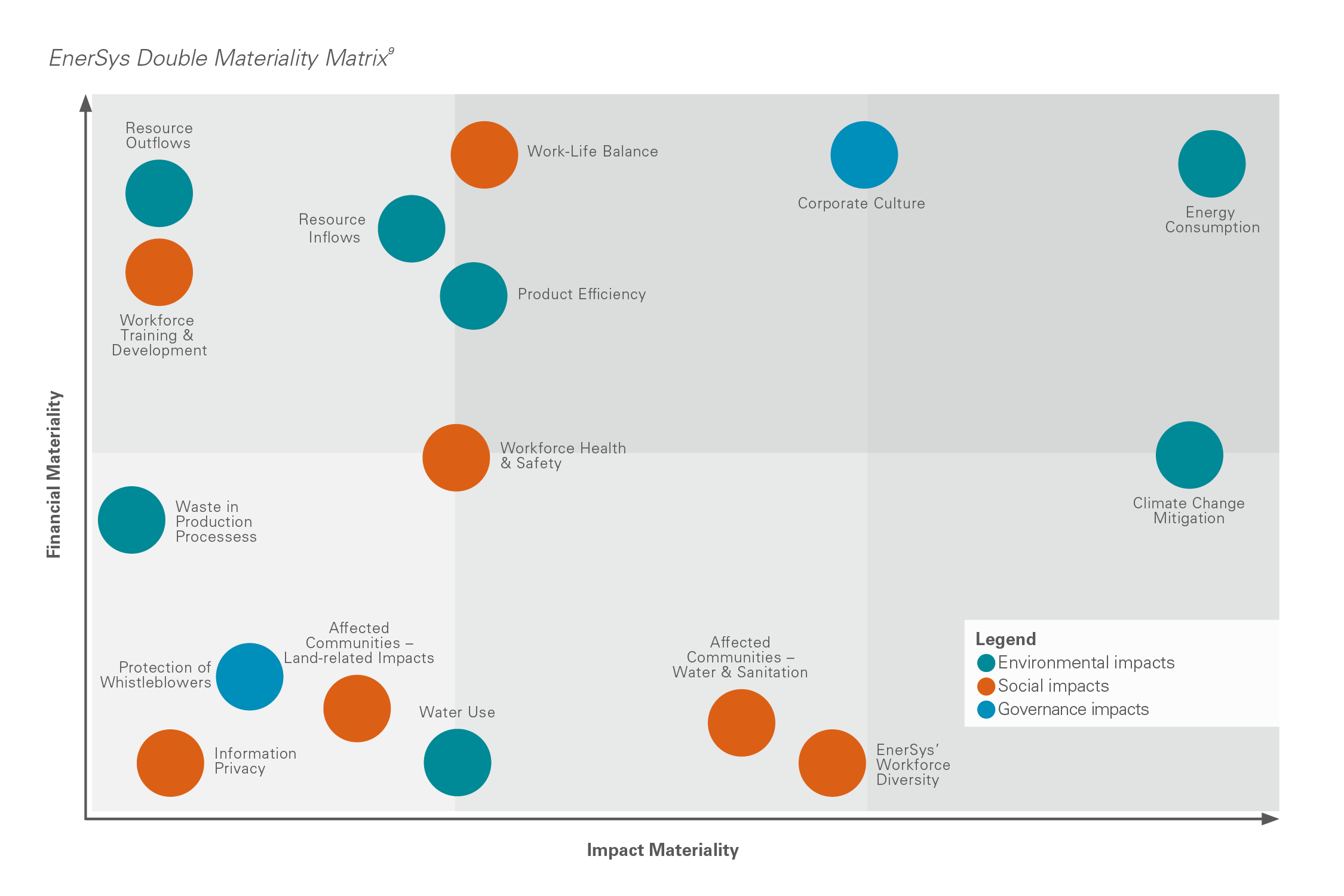
Double Materiality Assessment

In 2025, EnerSys engaged a third-party (Tracera) to conduct its Double Materiality Assessment using a structured six-step methodology aligned with the European Sustainability Reporting Standards (ESRS). Aligned with recognized best-practice, the process began with topic identification, informed by leading sustainability frameworks such as the ESRS topical standards, UN Sustainable Development Goals (SDGs), SASB, and ALLUVE.

Stakeholder engagement played a central role, with 63 participants contributing to the impact materiality survey and 11 to the financial materiality survey. These stakeholders, drawn from across the value chain, included employees, customers, investors, NGOs, governments, and suppliers. These stakeholders helped assess impacts based on severity (scale, scope, and irremediability), likelihood for impact materiality, magnitude (across financial, operational, reputational, and regulatory dimensions) and likelihood for financial materiality.

The assessment encompassed the company’s full value chain, from upstream tier 1 suppliers to downstream customers, ensuring both direct and indirect impacts were captured. Internal validation through interviews and expert input reinforced the rigor and alignment of the assessment with ESRS principles. Topics were deemed material if they exceeded predefined thresholds, supporting strategic prioritization and sustainable decision-making.

Aligned with best practice, EnerSys reviews the timing and scope of double materiality assessments in alignment with reporting needs and strategic priorities.


Sustainability Update FY2026

Learn how EnerSys is contributing to building a sustainable future